
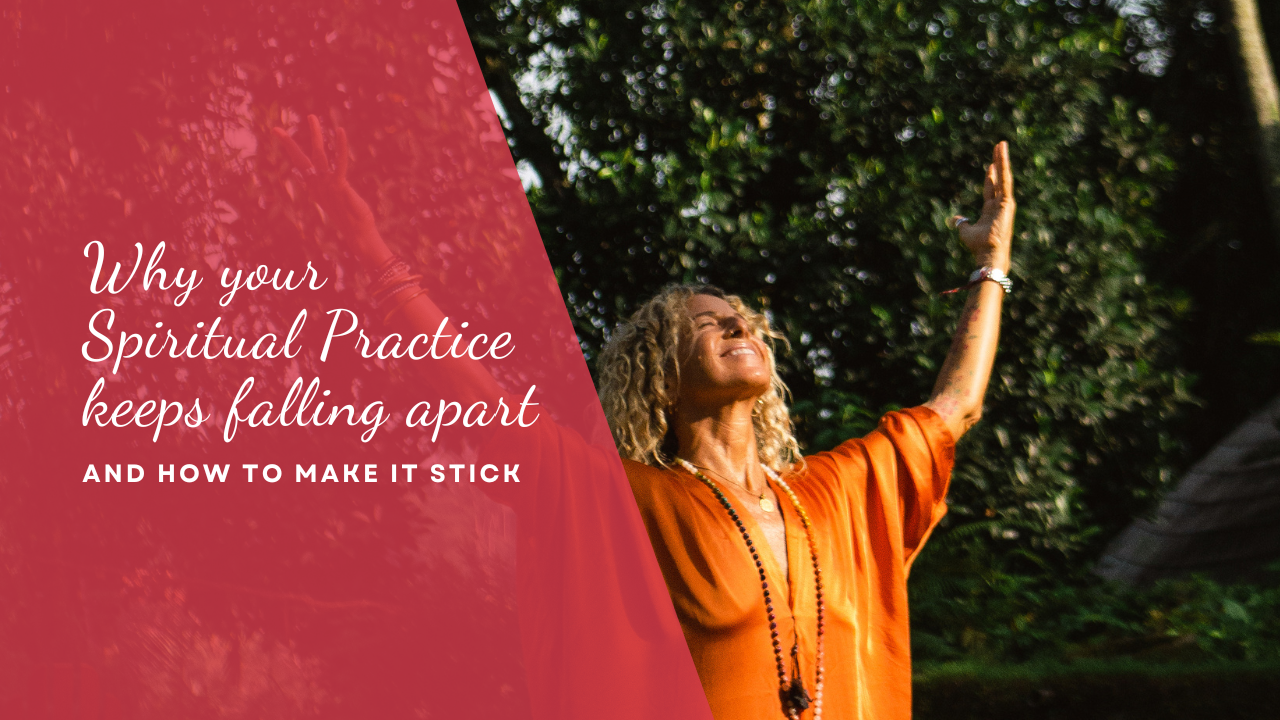
Why your Spiritual Practice keeps falling apart (and how to make it stick)
Dec 04, 2025You know the pattern well.
You wake up inspired, committed. This time will be different. You roll out your mat, light your candle, settle onto your cushion. For a week, maybe two, you show up. Your practice feels alive, nourishing. You can feel yourself changing.
Then life happens. A busy week at work. A cold that knocks you down. House guests. One missed day becomes three. Three becomes a week. The guilt creeps in. Your mat gathers dust in the corner, and that candle you lit with such intention sits unused.
Sound familiar?
If you've found yourself in this cycle (starting strong, gradually fading, feeling like you've failed, then starting over again) I want you to know something: You haven't failed. Your practice hasn't failed you. You simply haven't yet discovered how to build a practice that can hold you through all of life's seasons.
Let's explore what's really happening when practice falls apart, and more importantly, how to create a sadhana that sustains you for the long journey.
The real reasons practice falls apart
The perfection trap
"If I can't do my full hour-long practice, why bother at all?"
This is perhaps the most common reason practices crumble. We set beautiful, ambitious intentions: a full yoga sequence, twenty minutes of meditation, journaling, breathwork. When life contracts and we can't do it all, we do nothing. We've made our practice so grand that anything less feels like failure. But here's the truth: Five conscious breaths with full presence will transform you more than an hour of distracted movement. Your practice isn't measured by duration. It's measured by devotion.
You've lost touch with your 'why'
In the beginning, you might have started practicing because someone told you that you should. Because meditation is trending. Because you read that successful people have morning routines. These external motivations can spark the initial flame, but they won't sustain you through the challenging seasons.
When practice becomes something you do because you "should," it becomes another task on your to-do list. Another way you're not quite measuring up. Your sadhana must be rooted in something deeper—in the way it makes you feel, in the connection it brings, in the peace it offers your restless heart.
Life's natural rhythms feel like failure
You get sick. You travel. Your sleep schedule shifts. A family crisis demands your attention. These aren't failures, they're life. Yet we treat them as evidence that we can't maintain a practice, that we lack discipline, that we're not "spiritual enough."
What if, instead, we learned to see these moments as invitations? Invitations to practice flexibility, self-compassion, and creative adaptation. Your practice should support your life, not add more pressure to it.
You're practicing the wrong things at the wrong time
The practice that served you beautifully last year might not fit your life now. The vigorous vinyasa flow that energized you in your twenties might deplete you in your forties. The long meditations that once brought clarity might now feel like resistance. We change. Our needs shift. Our practice must evolve with us. Clinging to what used to work, even when it no longer serves, is a common way practice becomes burden instead of blessing.
The all-or-nothing mind
You miss Monday morning. Then Tuesday feels ruined because you've already "broken the streak." By Wednesday, you've mentally checked out for the week. This black-and-white thinking transforms one missed practice into complete abandonment. Your relationship with practice mirrors your relationship with yourself. If you can't offer yourself grace and flexibility here, where can you?
The sustainability shift: Building a practice that lasts
So how do we create something different? How do we build a daily practice that doesn't just start strong but sustains us through every season of our lives?
Start ridiculously small
I mean it. If you're rebuilding your practice or beginning for the first time, start with something so simple it feels almost laughable. Three deep breaths. One sun salutation. Sixty seconds of stillness. Make your initial commitment so small that you cannot fail. This isn't about lowering your standards, it's about honoring the truth of how transformation actually happens. Consistency creates change, not intensity. The practice you do every day for five minutes will reshape your life more than the practice you do for an hour once a month.
Once this tiny practice becomes as natural as brushing your teeth, you can expand. But start where success is inevitable.
Anchor to what already exists
Don't try to create an entirely new morning routine from scratch. Instead, attach your practice to something you already do without thinking. After you brew your morning coffee, sit with it for three mindful breaths before taking the first sip. Before you check your phone at night, place your hand on your heart and offer yourself one moment of gratitude. When you open your windows each morning, pause and set an intention for the day.
These micro-practices slip seamlessly into the rhythm of your existing life. They don't require you to become someone new. They simply invite more presence into who you already are.
Connect to feeling, not achieving
Here's a question that changes everything: How do you want to feel?
Not "what do you want to accomplish" or "what should you be doing," but how do you genuinely want to feel in your body, your heart, your spirit? Grounded? Open? Peaceful? Connected? Energized? When you design your practice around the feelings you're cultivating rather than the tasks you're completing, everything shifts. You're no longer checking boxes. You're creating conditions for your own flourishing.
Some days, that feeling comes through movement. Other days, through stillness. Some mornings, through silence. Other mornings, through chanting. When you're connected to the why beneath the what, your practice becomes infinitely more flexible and sustainable.
Build flexibility into the foundation
What if, instead of having one rigid practice, you designed three versions?
Version A: Your full practice, for days when you have spaciousness and energy.
Version B: Your essential practice, for busy mornings when time is compressed.
Version C: Your bare-minimum practice, for those days when just showing up is victory enough.
This isn't about making excuses or taking the easy way out. It's about building a relationship with practice that can hold you through all of life's variables. Some seasons are abundant. Others are lean. Your practice should be able to meet you in both.
Track presence, not perfection
What you celebrate, you sustain. If you track whether you did your practice "perfectly," you'll focus on your failures. If you track whether you showed up with presence, even for two minutes, you'll focus on your commitment. Create a simple way to acknowledge your practice. A checkmark in a journal. A stone moved from one bowl to another. A note in your phone. Make the ritual of acknowledgment part of the practice itself.
You're not tracking to judge yourself. You're tracking to witness your devotion, to see the thread of your commitment woven through your days.
Designing a practice that holds you
Over thirty years of practice has taught me this: The practices that last aren't the ones that look impressive. They're the ones that are so deeply woven into the fabric of your life that removing them would feel like removing a thread from cloth.
This is why I created The Power of Practice. Not a one-size-fits-all prescription, but a framework for designing a sadhana that's uniquely yours. A practice built on your needs, your rhythms, your truth.
Through seven weeks, we explore the essential elements: yoga, breathwork, meditation, mantra and Ayurveda. Not as separate techniques you must master, but as tools you can weave together in whatever combination serves your soul.
You'll learn how to start small and build sustainably. How to create flexibility within structure. How to recognize when to lean in and when to adapt. How to make practice feel like coming home instead of another obligation. Because the goal isn't to create a perfect practice. It's to create a sustainable one. A practice that meets you where you are and grows with you as you evolve.
Daily practice is more than discipline, it is devotion, remembrance, and refuge.
The Power of Practice was born from one of the most painful moments of my life. In the depths of grief, it was my sadhana—breath, mantra, ayurveda, prayer, ritual—that held me, healed me, and guided me back to my own soul.
This program is my offering to anyone who yearns for a spiritual anchor… a practice that can sustain you through both the beauty and the heartbreak of life. Whether your path is yoga, Tantra, bhakti, or any spiritual tradition, this course helps you build a daily ritual that becomes a source of strength, devotion, and profound inner connection.
Begin again, right now
You don't need to wait until Monday. You don't need a perfectly clear morning or a beautifully appointed space. You don't need to have it all figured out. You just need to begin.
Right now, wherever you are, take three deep breaths. Place your hand on your heart. Feel yourself here, alive, worthy of this devotion.
That's practice. That's the beginning. And tomorrow, you'll begin again. And the day after that. And the day after that. Not perfectly. Not without interruption. But with the steady, patient devotion of someone committed to their own unfolding. This is how transformation happens. Not in dramatic leaps, but in the quiet accumulation of present moments. In the sacred repetition of showing up for yourself, again and again and again.
Your practice is waiting for you. Not the practice you think you should have. The practice that's actually yours. Are you ready to discover what that looks like?